General Caravan Use Guide
We look at the basics of using a caravan and trouble shoot some of the basic common issues that hirers find.
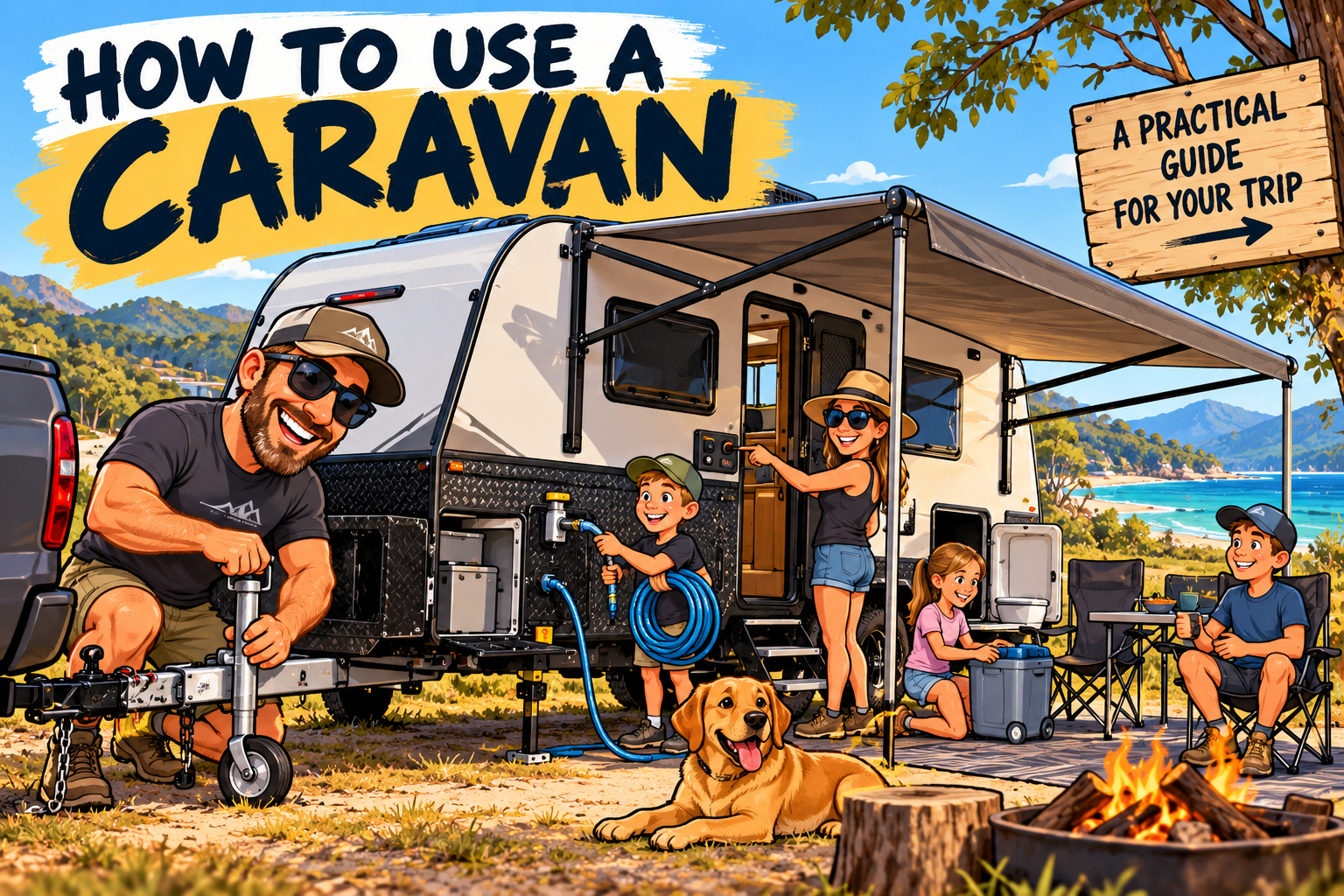
How to Use a Caravan: A Practical Guide for Your Trip
If you’re new to caravanning, there can seem like a lot to remember at first.
Power, water, batteries, toilets, awnings, hot water, fridges and setting up camp all work a little differently to what you may be used to at home.
The good news is that once you understand the basics, it’s all fairly straightforward.
This guide covers the general operation of a caravan and some of the most common things you’ll need to know during your Outbound Adventure.
Individual caravans do vary, so always follow the specific instructions provided with your caravan where they differ from this guide.
Before You Leave
Before travelling, do a complete walk-around of the caravan.
Check that:
All external storage doors are closed and locked
Windows and roof hatches are closed
The awning is fully retracted
The entry step is retracted
Power leads and water hoses are disconnected
Corner stabilisers are completely raised
Loose items inside the caravan are secured
Cupboards and drawers are latched
The fridge door is secured
The caravan is correctly hitched
Safety chains are connected
The electrical plug is connected to the tow vehicle
The breakaway cable is attached correctly
Caravan lights are working
It is worth doing this walk-around every single time you move the caravan.
Arriving at Your Campsite
Before unhitching, decide exactly where you want the caravan to sit.
Look at the location of:
Power outlets
Water connections
Drainage points
Trees and branches
Your awning
Your tow vehicle
Neighbouring campsites
Try to get the caravan reasonably level from side to side before unhitching.
If required, drive one side of the caravan onto levelling ramps.
Do not attempt to level the caravan using the corner stabilisers.
Once the caravan is in position:
Apply the caravan handbrake.
Chock the wheels.
Disconnect the electrical plug and breakaway cable.
Disconnect the safety chains.
Raise the caravan off the tow ball using the jockey wheel.
Move the tow vehicle away.
Lower the corner stabilisers until they are firmly touching the ground.
The stabilisers are designed to stop the caravan moving while you are inside. They are not designed to lift the weight of the caravan.
Connecting to Power
Most caravan parks provide a 240V power outlet at each powered site.
Use the supplied caravan power lead to connect the caravan directly to the campsite outlet.
Do not use ordinary household extension leads.
Once connected to mains power, the caravan can generally operate its 240V equipment and its battery charger will begin maintaining the caravan batteries.
Depending on the caravan, this may include:
Air conditioning
Microwave
Power points
Battery charger
Hot water system
Some cooking appliances
Caravan parks limit how much electricity each site can use.
If you operate too many high-powered appliances at once, you may trip the power supply.
For example, running the air conditioner, microwave and electric hot water together may exceed the available supply.
Using the Caravan Batteries
When the caravan is not connected to mains power, most of its basic equipment runs from the 12V battery system.
This normally includes:
Lights
Water pump
USB outlets
Television
Fridge on caravans fitted with a compressor fridge
Control panels
Fans
The batteries have a limited amount of stored energy.
Solar panels will help recharge them during daylight hours, but solar output changes significantly depending on weather, shade and the time of year.
Cloudy weather does not necessarily mean something is wrong with the caravan if the batteries aren’t charging quickly.
If you’re camping off-grid, regularly check the battery monitor and adjust your electricity use accordingly.
Connecting to Water at a Caravan Park
If your campsite has a mains water connection, connect the supplied drinking-water hose between the tap and the caravan’s mains-water inlet.
Turn the tap on gradually.
When connected to mains water, you generally do not need to run the caravan’s water pump.
The water pump is normally used when drawing water from the caravan’s onboard tanks.
Do not connect mains water to the water-tank filler.
Using the Water Tanks
When you’re camping without a mains-water connection, the caravan uses its onboard water tanks.
Turn the water pump on using the caravan’s control panel or designated switch.
Opening a tap should automatically activate the pump.
Remember that caravan water supplies are limited.
Showers, washing dishes and leaving taps running can use a surprising amount of water.
Turn the pump off when travelling and consider turning it off when leaving the caravan unattended.
Hot Water
Caravan hot-water systems vary depending on the caravan.
They may operate on:
LPG
240V electricity
Diesel
A combination of power sources
Before turning the hot-water system on, make sure there is water in the system.
Do not operate an electric hot-water system with an empty tank, as the heating element may be damaged.
After turning the system on, allow time for the water to heat.
If you are using LPG, make sure the gas bottle is turned on.
Using the Toilet
Most caravan toilets use a removable toilet cassette.
Before use, ensure the cassette is correctly installed.
The toilet normally has a sliding blade that opens the cassette beneath the toilet bowl.
After use:
Flush the toilet.
Close the toilet blade.
Check that it has completely closed.
To empty the cassette, access it through the external toilet compartment.
Remove the cassette and take it to an approved dump point.
Never empty toilet waste into stormwater drains, toilets that prohibit cassette disposal or onto the ground.
Only appropriate toilet chemicals and products should be used.
Do not put wet wipes, sanitary products or other unsuitable items into the toilet.
Grey Water
Water from the kitchen sink, shower and bathroom basin is called grey water.
Depending on the caravan, this may flow directly from a grey-water outlet or collect in an onboard grey-water tank.
Some caravan parks require a grey-water hose to be connected to a designated drain.
Other camping areas require grey water to be stored and removed.
Always follow the rules of the campground.
If your caravan has a grey-water tank, keep an eye on its level.
A full grey-water tank can cause sinks or showers to stop draining correctly.
Using the Fridge
The way your fridge operates depends on the type fitted to the caravan.
Compressor Fridges
A compressor fridge operates from the caravan’s 12V electrical system.
It can continue operating while travelling or camping off-grid, provided there is sufficient battery capacity.
Three-Way Fridges
A three-way fridge may operate on:
240V electricity
12V while travelling
LPG while camping
If you have a three-way fridge, follow the specific instructions supplied with your caravan.
Caravan fridges can take considerably longer to cool than household fridges, so avoid leaving the door open unnecessarily.
Using LPG
LPG may be used for:
Cooking
Hot water
Heating
Refrigeration
To use an LPG appliance, make sure the gas bottle valve is open.
If an appliance fails to ignite, turn it off and check its operating procedure before trying again.
If you smell gas:
Turn off the LPG supply.
Extinguish any flames.
Ventilate the caravan.
Do not operate electrical switches.
Do not continue using the gas system until the source has been identified.
Never use portable outdoor gas appliances inside the caravan.
Using the Awning
The caravan awning provides shade and creates a much larger outdoor living area, but it is also particularly vulnerable to wind.
Extend the awning according to the instructions for your caravan.
Once extended, secure it appropriately.
If rain is expected, it is generally a good idea to have one end of the awning slightly lower so water can run off rather than pool on the fabric.
More importantly, if strong winds or storms are expected, retract the awning.
Do not rely on ropes or straps to protect an awning during severe weather.
If you are leaving the campsite for an extended period and the weather is uncertain, put the awning away.
Air Conditioning
Most caravan air conditioners require 240V electricity.
They generally cannot operate from the caravan batteries unless the caravan has a system specifically designed to support this.
When using air conditioning at a powered campsite, be mindful of other high-powered appliances operating at the same time.
If the campsite circuit trips, turn some appliances off before resetting it.
Using the Shower
Caravan showers work much like a normal shower, but water supply and hot-water capacity are much more limited.
If camping off-grid, short showers will dramatically extend the amount of time your onboard water lasts.
Make sure the water pump is switched on if using the tanks.
After showering, check that the water is draining properly.
If it isn’t, the grey-water tank may be full or the drainage hose may be blocked or incorrectly positioned.
Cooking Inside the Caravan
Only use appliances for their intended purpose.
When using the internal gas cooktop:
Make sure there is appropriate ventilation
Keep flammable items away from the burners
Never leave cooking unattended
Check that all burners are turned off when finished
Never use outdoor barbecues, portable gas cookers or similar appliances inside the caravan.
Watch Your Height
Caravans are much taller than cars.
Air conditioners, solar panels, roof hatches and antennas can make the caravan taller than it appears from the driver’s seat.
Be particularly careful around:
Trees
Low branches
Service stations
Carports
Shopping centres
Covered parking areas
If you’re unsure whether the caravan will fit, stop and check.
Do not simply assume clearance is adequate.
Be Careful Around Trees
Branches can easily damage the roof, awning, windows and sides of a caravan.
Take your time when entering heavily treed campsites.
If necessary, have another person outside the vehicle guiding you.
Remember that branches can also move considerably in windy weather, so allow additional clearance when positioning the caravan for your stay.
Before Travelling Again
Before leaving your campsite:
Turn off appliances that shouldn’t operate while travelling.
Turn off the water pump.
Turn off the gas where required.
Disconnect the water hose.
Disconnect the power lead.
Empty or disconnect grey-water equipment.
Pack away chairs, tables and other campsite equipment.
Retract the awning completely.
Close and secure windows and roof hatches.
Secure everything inside the caravan.
Raise all corner stabilisers.
Hitch the caravan to the tow vehicle.
Connect the safety chains.
Connect the electrical plug.
Connect the breakaway cable.
Raise and secure the jockey wheel.
Release the caravan handbrake.
Remove the wheel chocks.
Check all lights.
Then walk around the entire caravan one final time.
Don’t rush this part.
If Something Doesn’t Work
Before assuming something has failed, check the simple things first.
No Water
Check:
Is there water in the tanks?
Is the water pump switched on?
Are you connected to mains water?
Is the campsite tap turned on?
No Hot Water
Check:
Is the hot-water system switched on?
Has it had enough time to heat?
Is there water in the system?
If using gas, is the gas bottle turned on?
No 240V Power
Check:
Is the caravan connected to campsite power?
Is the campsite outlet switched on?
Has a circuit breaker tripped?
Are too many high-powered appliances operating?
Battery Is Going Flat
Check:
What appliances are running?
Is the caravan receiving solar?
Is it parked in shade?
Has the weather been cloudy?
Are unusually high-power appliances being used?
Solar charging can vary significantly from one day to another.
Sink or Shower Isn’t Draining
Check:
Is the grey-water tank full?
Is the drainage hose kinked?
Is the drainage outlet blocked?
Fridge Isn’t Cold
Check:
Is it switched on?
Is the correct power source selected?
Has it had sufficient time to cool?
Has the door been left open?
Is the caravan’s battery level adequate?
Don’t Force Anything
One of the most important rules when using a caravan is simple:
If something doesn’t seem right, don’t force it.
Caravan components are generally lightweight by design.
Cupboard catches, awnings, windows, hatches, blinds and fittings can be damaged if excessive force is used.
If something isn’t opening, closing or operating normally, stop and check why.
Often there is a latch, lock, switch or simple operating step that has been missed.
Enjoy the Trip
Using a caravan does require a little more involvement than checking into a hotel.
You need to keep an eye on water, power, batteries, weather and the equipment around you.
That’s part of caravanning.
Once you’ve set up a few times, most of these jobs become automatic.
Take your time, look after the equipment and, if you’re unsure about something in your Outbound Adventure caravan, contact us before trying to force or dismantle anything.
We would much rather help you solve a small problem than have it become a big one.