The Caravan Boom Isn’t Over — Australians Are Just Travelling Differently
Australians are taking more caravan trips but spending fewer nights away. Cost-of-living pressures, shorter holidays and changing ownership habits are reshaping the caravan market.
The Caravan Boom Isn’t Over — The Market Is Just Changing
For a few years, Australia could not get enough caravans. COVID closed borders, overseas holidays disappeared and Australians suddenly looked for another way to travel. Caravanning offered freedom, flexibility and a way to get away without leaving the country.
The response was enormous. Waiting lists blew out, manufacturers expanded, new brands appeared, dealers struggled to get enough stock and second-hand caravans commanded extraordinary prices.
For a while, it felt like the boom might never end.
Then the market changed.
Stock became easier to find. Buyers became more cautious. Manufacturers and dealerships came under pressure, and some disappeared altogether.
It would be easy to look at that and assume Australians had simply fallen out of love with caravanning.
The numbers suggest something much more complicated.
Australians still love camping. The real story may be a combination of too much supply, growing pressure on household finances and a market that already has an enormous number of caravans in it.
First came the boom
The COVID years created almost perfect conditions for caravan sales. International borders were closed, domestic travel became one of the few holiday options available and money that might normally have been spent overseas stayed in Australia.
The industry responded quickly. Manufacturers increased production, new businesses entered the market, imports grew and dealer yards filled with stock.
Australia’s recreational vehicle fleet grew with it. By 2025, there were almost 938,000 registered caravans, campervans and other RVs in Australia — around 32% more than in 2019.
That is an extraordinary increase in only a few years.
But eventually the conditions that created the boom disappeared.
Then came the squeeze
Borders reopened and overseas holidays returned just as household finances started coming under pressure. The cost of living rose, discretionary income tightened and large lifestyle purchases became much harder to justify.
Government policy and the broader economic environment have also added pressure to the amount of money households have available after the essentials are paid.
For the caravan industry, that matters. An $80,000, $100,000 or $150,000 caravan is very different to a grocery bill or electricity account. It is a purchase people can delay.
The problem is that supply did not disappear at the same time.
Australian manufacturers still produced 23,963 RVs in 2025. That was down around 5% on the previous year, but still above pre-COVID production levels.
Then there are imports.
Australia imported 23,244 caravan trailers and related components in 2025, an increase of around 16% in a single year, with a free-on-board value of more than $619 million.
So while consumers were becoming more cautious, tens of thousands of new locally manufactured and imported products were still entering the market.
Local manufacturers were no longer simply competing with each other. They were also competing with a growing volume of imported product, often at aggressive price points.
Suddenly the industry was facing a very different equation: nearly one million RVs already registered, almost 24,000 more being locally manufactured in a year, more than 23,000 caravan trailers and related components being imported, and consumers with less discretionary money available to buy them.
That is a very different market from the one that existed during the COVID boom.
But Australians haven’t stopped caravanning
This is where the story becomes particularly interesting.
If the caravan market was struggling because Australians no longer wanted the lifestyle, you would expect camping participation to be falling as well.
It isn’t.
Australians took a record 17.3 million caravan and camping trips in 2025, spending 57.9 million nights away and around $12.6 billion in the process. Almost one in every seven domestic overnight trips involved caravanning or camping.
Caravan parks also generated record revenue.
Clearly, people still want to travel this way.
They still want the beach, the bush, the caravan park and the weekend away. What appears to be becoming harder is the financial leap between enjoying caravanning and spending $100,000 to own a caravan.
That distinction is important.
There can be extremely strong demand for the lifestyle at the same time as demand for the asset becomes weaker.
Then there is the question nobody can really answer
With almost 938,000 RVs already registered in Australia, there is another issue hanging over the industry.
How many more Australians actually want to own one?
There are only so many households that want the caravan lifestyle, have somewhere to store a van, own a suitable tow vehicle, have enough spare time to use it and are willing and able to spend $80,000, $100,000 or considerably more to buy one.
Maybe there is still an enormous pool of buyers waiting for economic conditions to improve.
But there is another possibility.
The COVID boom may have pulled forward years of future demand. Someone who might normally have bought a caravan in 2024, 2025 or 2026 may instead have bought one in 2020 or 2021 because international travel was unavailable.
And with close to one million RVs already registered, perhaps a large proportion of Australians who genuinely want to own one already do.
Nobody really knows.
But it may be one of the most important questions facing the industry.
Because if participation in caravanning continues to grow while ownership demand becomes harder to generate, simply building more caravans is unlikely to recreate the boom.
Supply doesn’t stop just because demand slows
This is where the import numbers become particularly important.
Imports increased around 16% during 2025, meaning more product was competing for buyers at exactly the time those buyers were becoming more cautious.
Competition is not necessarily a bad thing. It gives consumers more choice, encourages manufacturers to improve products and puts downward pressure on prices.
But for businesses that expanded factories, staff, dealerships and inventory during a once-in-a-generation demand boom, it also creates a serious problem.
There can simply be too many businesses and too many caravans chasing the number of people currently willing and able to buy one.
That is where a boom can begin to look like a bust, even while Australians continue taking record numbers of caravan holidays.
Maybe the market isn’t shrinking. Maybe it is changing.
For decades, the basic caravan industry model has been straightforward: if you want the caravan lifestyle, you buy a caravan.
But the travel numbers suggest the customer may increasingly separate those two things.
You can want to caravan without necessarily wanting to own the asset.
We have already seen that shift begin.
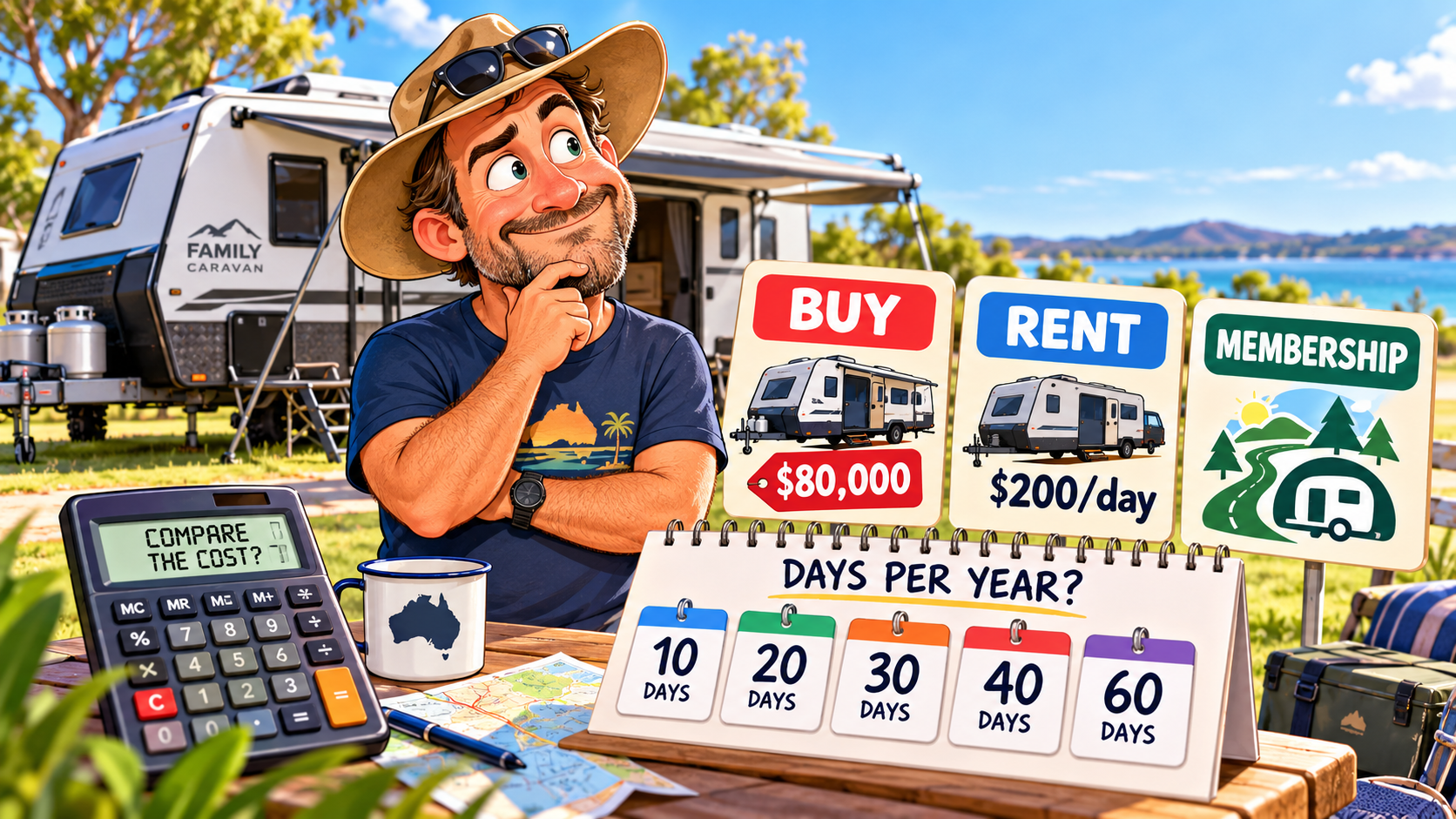
Rental was the first major change. Platforms such as Camplify demonstrated there was a substantial group of Australians effectively saying, “I want the caravan holiday, but I don’t necessarily want to buy the caravan.”
For someone taking an occasional trip, that model makes sense. They use the caravan, return it afterwards and pay for the holiday rather than carrying the cost of ownership all year.
But rental also leaves a gap.
Once someone wants to travel several times a year, repeatedly paying a daily rental rate becomes expensive. They are no longer an occasional renter, but they may still not want to own a caravan.
That is where membership created another option.
Unbound RV became the world’s first caravan membership platform, introducing an access model between traditional rental and ownership.
The difference is simple. Ownership means buying the caravan. Rental means paying each time you use one. Membership means paying for ongoing access.
That allows someone to genuinely love caravanning and travel regularly without necessarily having $100,000 tied up in a caravan sitting at home for most of the year.
Maybe we are looking at the wrong boom
Perhaps the caravan boom is not over.
Perhaps the ownership boom is.
Australia already has almost one million RVs on the road. Australians are taking record numbers of caravan and camping trips, caravan parks are generating record revenue and rental has already demonstrated that people are willing to access caravans without owning them.
Membership has taken that idea another step further.
So perhaps the next phase of growth should not be measured only by asking:
How many more caravans can Australia sell?
A better question might be:
How many more Australians can the industry help go caravanning?
Because the demand for the lifestyle still appears incredibly strong.
People still want the beach, the campfire, breakfast outside, the kids riding around the caravan park and a few days away where nobody particularly cares what day it is.
What is changing is the economics of how they get there.
The caravan industry may therefore be facing something more complicated than a simple boom and bust.
Ownership, supply, affordability and participation are no longer necessarily moving in the same direction.
And that may turn out to be the real story of Australia’s post-COVID caravan market.
Love caravanning, but not sure ownership still makes sense?
Unbound RV was created for people who want regular access to the caravan lifestyle without necessarily owning the caravan.