13 Caravan Companies in 12 Months: What It Means for Buyers
In the past 12 months, 13 separate companies across eight Australian caravan manufacturing and importing groups have entered administration or liquidation. With thousands of caravans a year tied to these businesses, the fallout raises serious questions around deposits, warranties
13 Caravan Companies in 12 Months: What It Means for Buyers
Buying a caravan has always involved a significant financial commitment.
But over the past 12 months, another risk has become increasingly difficult to ignore:
The company standing behind your caravan may not always be there when you need them.
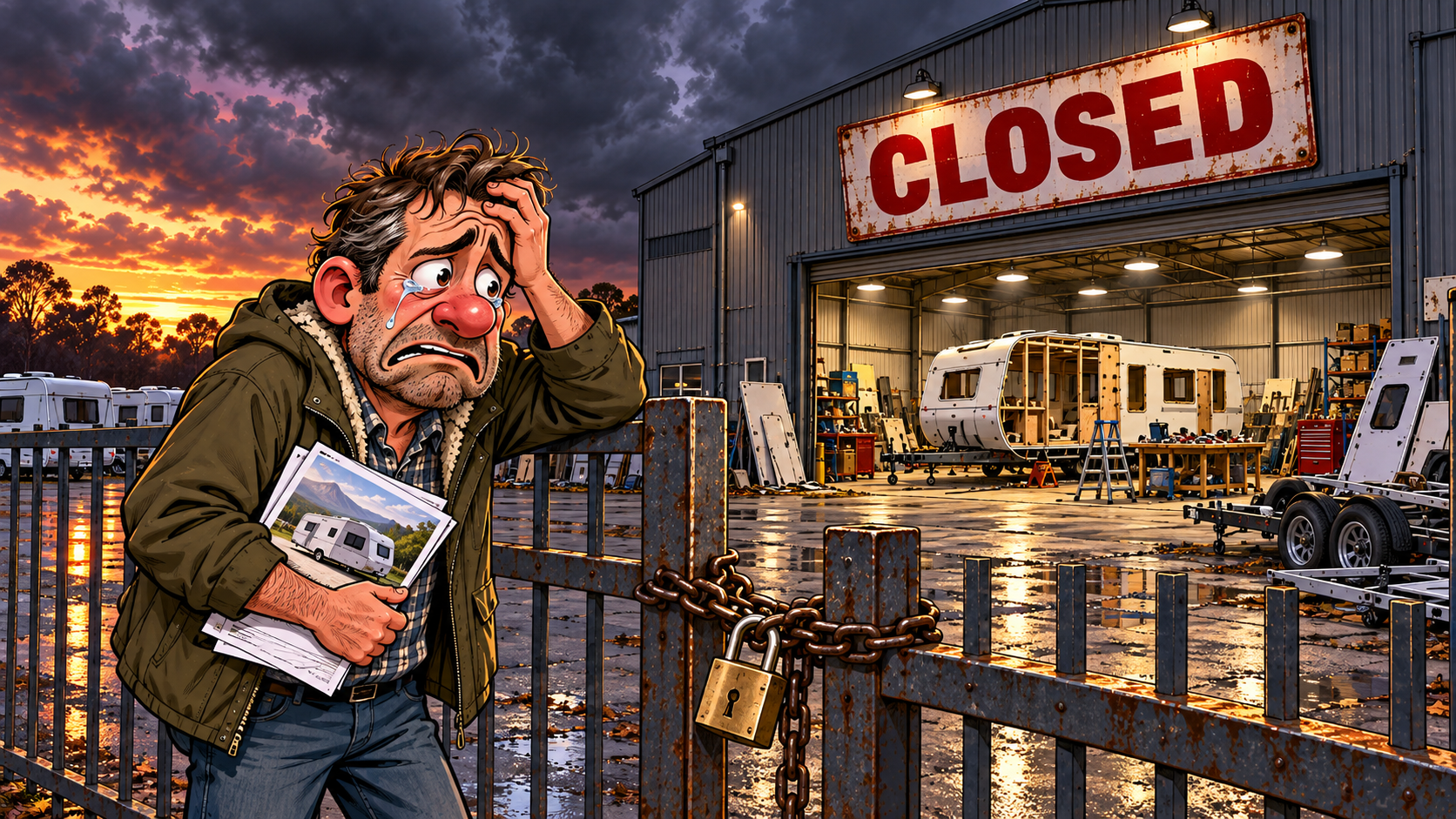
Between September 2025 and September 2026, we identified 13 separate legal entities across eight Australian caravan manufacturing and importing groups that entered administration or liquidation.
They include companies associated with:
Zone RV
Network RV, NextGen, Victory and Vancraft
Sunland, Phoenix and X-Series
Great Aussie Caravans
Ourgen RV
Star Vision
Australian Off Road
My Dream RV
Some of these brands have since been purchased or relaunched under new ownership. Others have not.
This doesn’t mean Australians have stopped caravanning.
Far from it.
But it does show that buying a new caravan today involves more than simply choosing a layout, negotiating a price and arranging finance.
There is now another question worth considering:
How much risk are you taking on when you hand over your money?
These weren’t all small caravan builders
It would be easy to assume these were mostly small manufacturers producing a handful of vans each year.
They weren’t.
Recent production data shows that several of the affected manufacturers were significant players in the Australian market.
Network RV was producing around 900 caravans and camper trailers a year.
Sunland had been producing more than 400 units annually.
Before its collapse, Zone RV was producing around 12 caravans per week, or more than 600 units a year at that production rate.
Australian Off Road reported building around 250 caravans in 2025.
Those four manufacturers alone represented more than 2,100 caravans a year of production.
And that doesn’t include Great Aussie Caravans, My Dream RV, Ourgen RV, Star Vision or the imported X-Series range.
So this wasn’t simply a few tiny manufacturers disappearing from the edges of the industry.
A meaningful amount of Australian caravan production and importing capacity has been caught up in insolvency proceedings over a remarkably short period.
The biggest risk may be the money you pay before your caravan exists
This is where things become particularly important for anyone considering ordering a new caravan.
It is common for manufacturers to require a deposit when an order is placed.
Many also require progress payments while the caravan is being built.
Normally, buyers hand over that money expecting their caravan to arrive a few months later.
But what happens if the manufacturer fails before delivery?
The collapse of Zone RV provided a very confronting example.
Customers had paid millions of dollars in deposits and progress payments toward caravans that had not yet been delivered.
Some individual customers had already paid well over $100,000.
Australian Off Road provided another recent example, with nearly 50 customers reportedly exposed to around $2.25 million in deposits and progress payments when the business entered administration.
Suddenly, the question isn’t just:
“Can I afford this caravan?”
It becomes:
“How much money am I comfortable handing over before the caravan is actually mine?”
For many families, that could be one of the largest unsecured payments they ever make.
If you’re buying, think about protecting your deposit
There is no perfect way to remove the risk, but buyers can try to minimise how much of their money is exposed before they receive the caravan.
One of the simplest options is to keep the initial deposit as small as reasonably possible and avoid handing over large additional payments until the caravan is complete and ready for delivery.
You can also ask whether the deposit can be held in trust or escrow rather than becoming part of the business’s normal operating cash. Not every dealer or manufacturer will agree to this, but it is worth asking.
Where practical, paying a deposit by credit card may provide additional dispute or chargeback options compared with transferring money directly into a bank account, depending on the circumstances and your card provider.
It is also worth checking exactly which legal entity you are paying. Make sure the company on the contract, invoice and bank account is the business you believe you are dealing with. Check its ABN and ASIC records and understand the refund and cancellation terms before transferring a substantial amount.
Most importantly, try to keep the bulk of the purchase price in your own account until the caravan is finished, inspected and ready for handover.
None of these steps provides a guarantee.
And a dealer or manufacturer may simply refuse smaller deposits, trust arrangements, credit-card payments or changes to its standard payment terms. That does not automatically mean there is anything wrong with the business.
But with tens of thousands of dollars potentially at risk, it is reasonable to ask the questions.
The less money you have exposed before receiving the caravan, the less you stand to lose if something goes wrong.
What happens to your warranty if the manufacturer disappears?
This is another area buyers may not think much about until something goes wrong.
A manufacturer entering liquidation does not automatically mean every consumer right disappears.
Australian Consumer Law protections may still apply, particularly against the dealer or business that sold you the caravan.
Parts and servicing may also remain available.
But manufacturer-backed warranty support can become far more complicated.
In some recent cases, brands and intellectual property have been purchased by new owners, allowing the brand to continue.
That sounds reassuring.
But buying a brand does not necessarily mean taking on the old company’s:
customer deposits
existing contracts
warranty obligations
debts
liabilities
So the caravan brand on the side of your van may continue to exist.
The company that originally promised to warrant it may not.
For an existing owner, that can mean more uncertainty around repairs, parts and support.
For a buyer waiting on a new caravan, the risk can be considerably greater.
The caravan market itself is changing
There is a broader story here too.
Australian caravan and RV manufacturing has fallen significantly from the huge post-COVID production levels.
At the same time, imports have increased and now represent a much larger share of the Australian market.
That creates more competition for local manufacturers.
Add higher interest rates, rising material and labour costs, tighter household budgets and large amounts of dealer stock, and the industry looks very different from the boom years when manufacturers were struggling to keep up with demand.
Australians still love caravan holidays.
But that doesn’t necessarily mean Australians want to spend $100,000 or more buying a new caravan.
And increasingly, there are other ways to travel.
The real cost of caravan ownership
At Unbound RV, we spend a lot of time talking about the real cost of owning a caravan.
Because the purchase price is only the beginning.
There is also:
depreciation
finance interest
insurance
registration
maintenance
servicing
repairs
storage
accessories and upgrades
And for many families, all of those costs are being carried for a caravan that may only be used for a few weeks each year.
The recent manufacturer collapses add something else to the equation:
Business risk.
It is difficult to put a dollar figure on that.
But for customers who have lost deposits, are waiting to see what happens to their order, or are trying to work out who will honour their warranty, it is very real.
Why Unbound RV is different
This is one of the reasons we created Unbound RV.
You shouldn’t necessarily have to own a caravan just because you love caravan holidays.
With Unbound, our members can access a caravan when they want to travel without investing $80,000, $100,000 or $150,000+ into owning one.
We own the caravan.
We carry the depreciation.
We organise the insurance and registration.
We manage servicing and maintenance.
We deal with repairs and manufacturer issues.
And importantly:
Our members aren’t handing tens of thousands of dollars to a manufacturer and waiting months for a caravan to be built.
You use the caravan.
We worry about owning it.
Does that mean nobody should buy a caravan?
Of course not.
For someone travelling for months every year, or someone who simply loves having their own caravan set up exactly the way they want it, ownership can still make perfect sense.
But buying shouldn’t automatically be the default just because you enjoy caravanning.
Before spending $100,000 or more, it is worth asking:
How many nights a year will I actually use it?
What will it really cost me every year?
How much will it depreciate?
Where will I store it?
How much money am I prepared to have tied up before delivery?
And perhaps now:
How comfortable am I relying on the manufacturer still being there years from now?
There is another way to caravan.
Before you buy, run the numbers
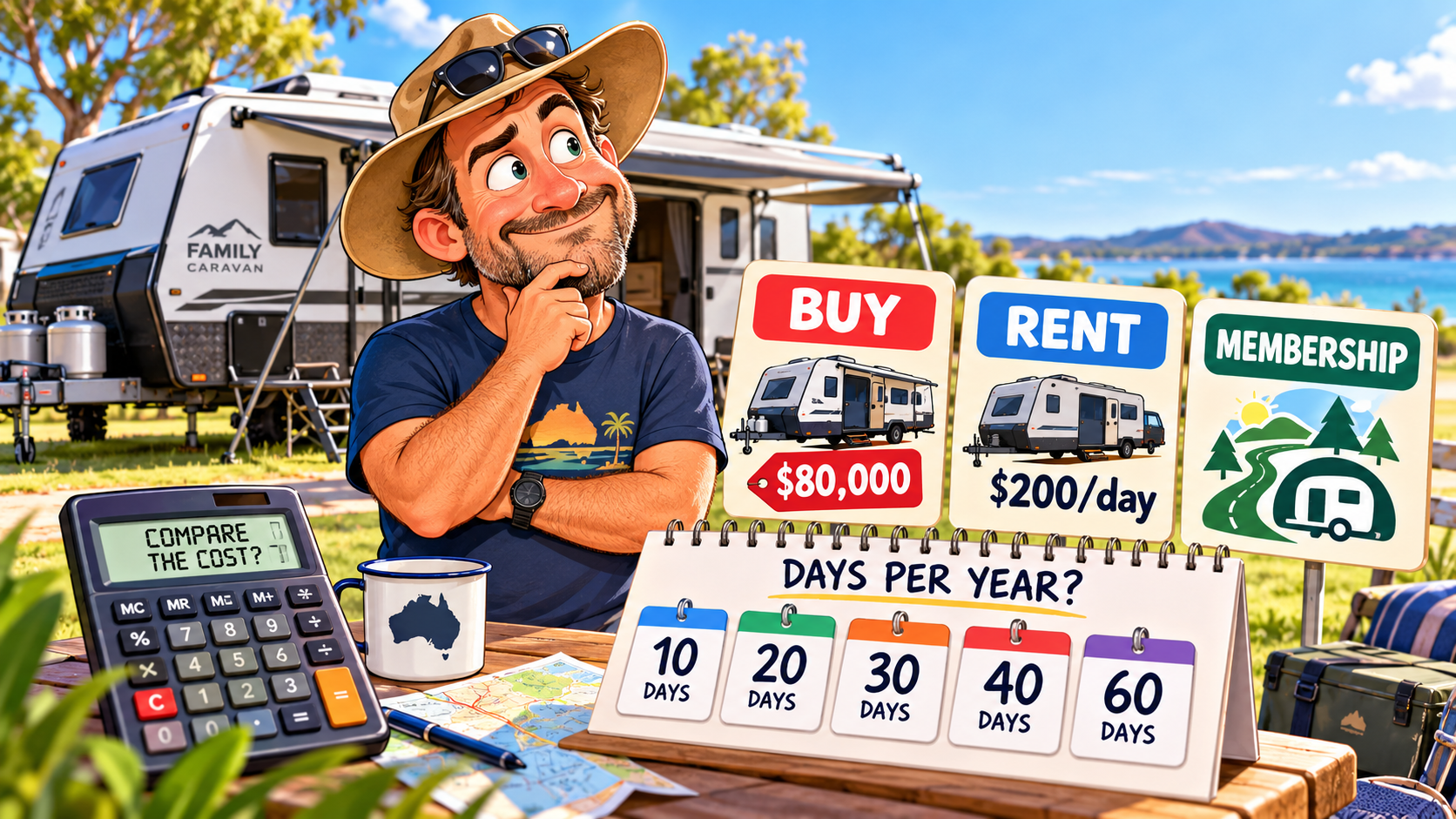
Before committing to a new caravan, compare the real cost of ownership.
Our Unbound RV Caravan Ownership Calculator lets you compare the cost of buying against renting or joining Unbound RV based on how often you actually travel.
https://unboundrv.com.au/caravan-cost-calculator/?test=123
Because the best caravan decision isn’t necessarily the one that puts a caravan in your driveway.
It’s the one that lets you travel the way you want without carrying costs and risks you don’t need.
Update — 2 October 2026
Since this article was published, Maverick Campers has also entered liquidation, adding another name to the growing list of caravan businesses under pressure.
That brings the tally identified in this article to at least 14 companies across nine separate groups in just over 12 months.
There are also signs of broader strain beyond formal insolvencies. Essential Caravans has announced the closure of its Somerton manufacturing facility and the consolidation of production into Pakenham, citing challenging market conditions.
Essential remains operating, so it should not be grouped with businesses in administration or liquidation. But the timing reinforces the broader point of this article:
The pressure on Australia’s caravan industry is still building — and the story is moving quickly.